The current state of British parliamentary politics in mid 2025
Published:
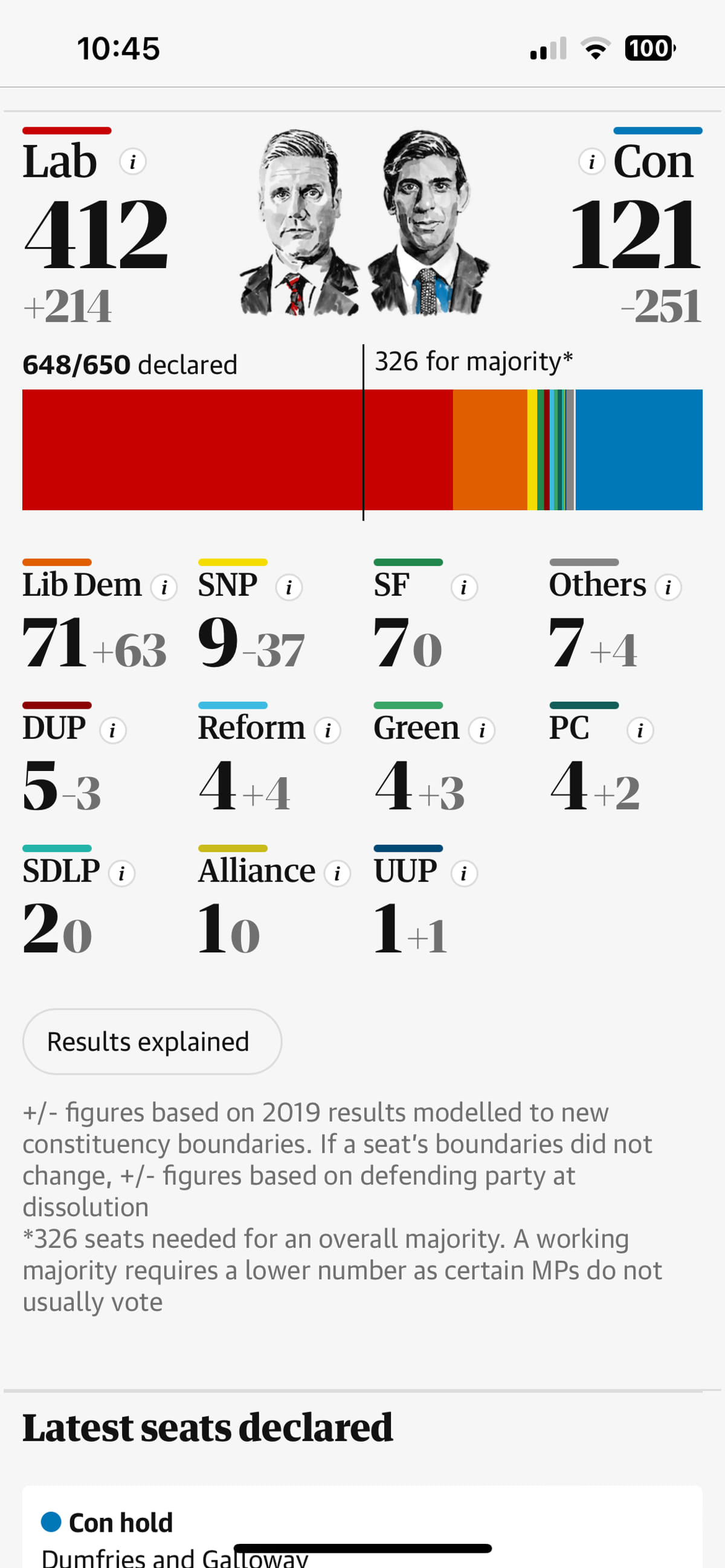
A survey of the current state of British politics in mid 2025
Kemi Badenoch and the Conservatives
After the calamitous - for the Tories - end of the Johnson/Truss/Sunak government in July 2024 the Conservative membership elected Kemi Badenoch as their leader without a particularly contested leadership campaign. Maybe they and the public were just tired of repeated Tory leadership campaigns clogging up Britain's current affairs TV schedules.
Kemi has been more present in the media than on the ground and does not seem, so far, to have had much impact. She seems more comfortable on policy strategy than when considering the daily lives of ordinary Britons, who after all do most of the voting.
In the May 2025 local elections the Conservatives suffered a huge loss of council seats, and one would have expected more of a reaction to that from high profile Tory supporters than there was. Perhaps many had already decided to flee to ReformUK.
The Tories left quite a mess in 2024. Standards of living were deteriorating and the quality of life of many British people was lower than when the Tories came to office in 2010. Growing inequality is arguably one of the biggest problems facing Britain, as demand in its economy needs to come from a broadly affluent body of citizens, not just from the 5% wealthiest who seemed to benefit from Tory austerity policies. Brexit knocked 4% off of Britain's GDP which did not help.
Endless Tory austerity became self-perpetuating and created the danger that the economy could stall as lower demand took the bottom out of it. The endless austerity was admittedly broken briefly by Boris before COVID cruelly halted his 'levelling up' because the money had instead to go to furloughed workers. Sometimes, as Boris realised, wise government spending can help an economy.
The Tory strategy of buying off the middle class with tax cuts could not and did not work forever. Every citizen has one vote. One gets the impression with the Conservative Party that bigotry trumps economics and everything else.
In the July 2024 General Election the Tories were so crushed that they may not be an election winning force for several years. Furthermore the scale of their failure may have caused a permanent shift in the conservative centre-right vote to ReformUK.
There are now hints that the Tories may terminate Kemi's leadership before the next general election. Dominic Cummings has said as much, if anyone is listening. The Tories may elect Robert Jenrick and try to out-Reform Reform, or out-Farage Farage. The question is - can they beat Farage at his own game? And would this result in further haemorrhaging of their centre right voters to the Liberal Democrats.
Keir Starmer and Labour
Labour won a landslide victory in 2024. A part of that was voter perception that 'no drama Starmer', as associates call him, was a safe pair of hands compared to say, Liz Truss.
Starmer's big weakness has turned out to be his delegation judgement and subsequent trust in his chosen Ministers. For example Rachel Reeves, his Chancellor of the Exchequer, has made some big mistakes. Employers' National Insurance rises, removal of some disability payments and the blanket removal of the winter fuel payment from pensioners ranging from millionaires to the poorest.
Meanwhile Ed Miliband, Starmer's Energy Minister, seems to be moving faster on Net Zero than some of his colleagues are comfortable with. Opponents such as ReformUK are scoring direct hits on Labour by accusing them of wasting a lot of money on Net Zero, which they claim has given Britain the world's most expensive energy. (It is worth pointing out that privatised energy companies had already given us expensive energy when Labour came into office!) All the same Labour's opponents are scoring an awful lot of direct hits.
Finally Wes Streeting, Starmer's Health Minister, does not seem to be making much progress on the National Health Service. There are still no NHS dentists in Beverley.
Starmer's Labour government seems to lack the maneuverability of Tony Blair, the calculation of Gordon Brown, the savvy of Peter Mandelson or the bullishness of Alistair Campbell. It has introduced some bad policies and did not sell them very well!
The May 2025 local elections saw Labour lose a lot of council seats in areas where they usually win. This must have worried their strategists.
The Hamilton Scottish parliament by-election in June 2025, won by Labour, offers a ray of hope to Starmer that his government is not a General Election write-off just yet. Some of its enemies and friends were writing its epitaph already, describing it as a mediocre 'centre-right' government.
Ed Davey and the Liberal Democrats
In July 2024 Ed Davey, current leader of the Liberal Democrats, convinced voters that his party is still relevant as a national force. The Lib Dems won 72 seats, their best result in many years.
The best Liberal Democrat leaders, such as Paddy Ashdown and Charles Kennedy, had charisma, and though Ed has less, he does project a sense of humour and humanity. Also he has compassion, especially in his campaigning for carers. This contrasted effectively against the harshness of the Tories and ReformUK.
The 2025 local elections showed the Lib Dems as very much alive in grass root politics, and caused Kemi Badenoch to score an own goal by mocking their community focus. For several years the Lib Dems have been quietly gaining seats in local government - a sign of trust.
The Lib Dems now seem to have a clear identity in the widening political and ideological space - maybe a vacuum - between the rightist Conservatives and ReformUK, and the only slightly leftist Labour party. If the Tories lurch to the right, and Labour follows them to the centre-right, there could be space for the Lib Dems to thrive by offering compassion and liberal radicalism.
The Lib Dems do have a cohesive set of leftish liberal social and economic policies which should in theory be attractive to a broad range of voters. A big problem is that they have been denied media coverage to be able to sell those policies. Week after week ReformUK, with only a handful of parliamentary seats, are platformed on national television while the Lib Dems get little coverage.
As ever there is the question of whether the Lib Dems can make a big electoral breakthrough in Britain's change-resistant two-party system. But if ReformUK split that system by poaching working class voters from Labour heartlands, and Tory voters from the county shires, the Lib Dems could benefit from everyone else's vote anaemia.
Nigel Farage and ReformUK
Nigel Farage's Reform Party concentrates on anti-woke warfare, anti-ecology warfare, and the far-right constant of immigration, supplemented recently by the difficult problem of UK grooming gangs. In 2024 it gained 5 MPs and is polling very well in national opinion polls. Its rise has been helped by the fact that the Tories, in their last couple of years, were perceived to have completely lost control of both legal immigration and illegal English Channel migrant crossings. ReformUK benefitted hugely from this.
ReformUK now claims that it has more members than the Conservative Party and sees itself as the replacement for the Tories on the right of British politics. For sure, ReformUK is the Conservative Party many Tories always dreamed of. Nadine Doris has joined them. Liz Truss has apparently talked to them - no further comment necessary. For left leaning Tories this may be scary - those Tories may shift to the Liberal Democrats or stay put.
The 2025 local elections saw ReformUK do very well across a range of councils. They took control of Lincolnshire, Durham, Doncaster and many more, gaining a spectacular 677 councillors from both Conservatives and Labour. There is no doubt that the party is now a serious force.
ReformUK has seen tumultuous internal politics - perhaps inevitable given its rapid growth. Its chairman, Zia Yusuf, resigned then apparently unresigned. One of its MPs, Rupert Lowe, has effectively been expelled from the parliamentary group.
The big question with ReformUK is - do they simply frighten too many voters? For example on healthcare they want to fundamentally reform the NHS, but detailed plans are not given and there are hints of Trump-like healthcare murkiness from Farage. They also want to completely abandon Net Zero and senior leader Richard Tice flatly denies climate change. Then there is their attitude to race and ethnicity, which seems to permeate nearly all of their policies - but Britain is now irreversibly multicultural and multiracial. Some fear that ReformUK could unleash more than even they anticipate from the far-right's increasingly fractious culture-war politics.
The next few years will reveal if ReformUK has grasped the complexity of governing one of the world's major countries with one of its largest economies.
Rob Swinney and the SNP
Rob Swinney, the Scottish National Party leader, inherited a weak position in Scottish politics from his predecessor Humza Yousaf, who in turn had inherited a great position from Nicola Sturgeon. Like his predecessors he wants a second independence referendum for Scotland in the light of Brexit and the deteriorating British economic position. Swinney seems to lack the voter appeal of Sturgeon in her heyday, as did Yousaf.
The SNP dream of a fully independent Scotland would break up the United Kingdom. Additionally there are doubts about Scotland's ability to maintain its public services without financial support from England; in fact Scotland theoretically could go bankrupt if it became a fully independent country. No doubt these risks and the potential benefits of independence will continue to concentrate the minds of Scottish voters, and decide the future of the SNP itself.
The spectacular nature of Nicola Sturgeon's fall from power, and her husband's legal difficulties, and the long SNP row about gender identity left the Scottish public wary of the SNP leadership. With the Labour Party resurgent in Scotland, the SNP lost 37 seats in parliament in 2024. This was an unabridged disaster. In July 2025 Labour won the Hamilton by-election leaving the SNP looking vulnerable to its auld rival.
The Scottish parliament elections in May 2026 will be a nervous time for the SNP.
The Green Party
The Green Party saw its share of the vote rise in the 2024 election and now has four MPs, its best result yet. Green ideas such as renewable energy and recycling are now mainstream, so the Greens unsurprisingly are making inroads into the British parliament and local government. Maybe this is inevitable as many of their ideas have been co-opted by the other major parties.
As the Green star slowly rises, the young are a big constituency for the party which hints at rays of renewable hope. Another good sign has been local election results of May 2023 and 2025 which saw the Greens gain many councillors. This shows that they are building a solid grass roots political movement.
Summary
The General Election campaign of 2024 saw Labour seize and hold a huge lead in the opinion polls, the emphatically win the voting. The Greens, ReformUK and the Liberal Democrats also benefitted from Tory voter flight. Consequently we have the most politically diverse parliament in many years.
Predictions about British national politics are currently no easier to make than usual. The Labour Party now has 412 MPs giving it a secure grip on power. The Conservative Party, with just 121 seats, and ReformUK stealing its support, is looking at the possibility of an extinction event. The Liberal Democrats is in rude health both nationally and locally. The SNP is facing a collapse of its power base. The Greens slowly gain traction locally and nationally.
Perhaps coalitions could feature in the next General Election: ReformUK and the Conservatives vs the other individual parties. Many people would see this alliance as an unappealing blue-purple force for regression. Others as the saviors of the nation.
Brexit in 2020 caused Britain's GDP to fall by about 4% so far and COVID saddled the country with yet more debt. That exasperated a situation where the government was already running out of money. The 1946 welfare, pension and healthcare system is stressed, but this time there is no knight in armour in the shape of the Blair-Brown government flush (for a while) with cash. Britain, like many other developed nations, also faces the strategic problem of falling birth rates and a growing number of elderly - where is the growth and economic activity to come from to fund services?
No doubt British politics will be heated as our politicians try to grapple with these huge challenges.